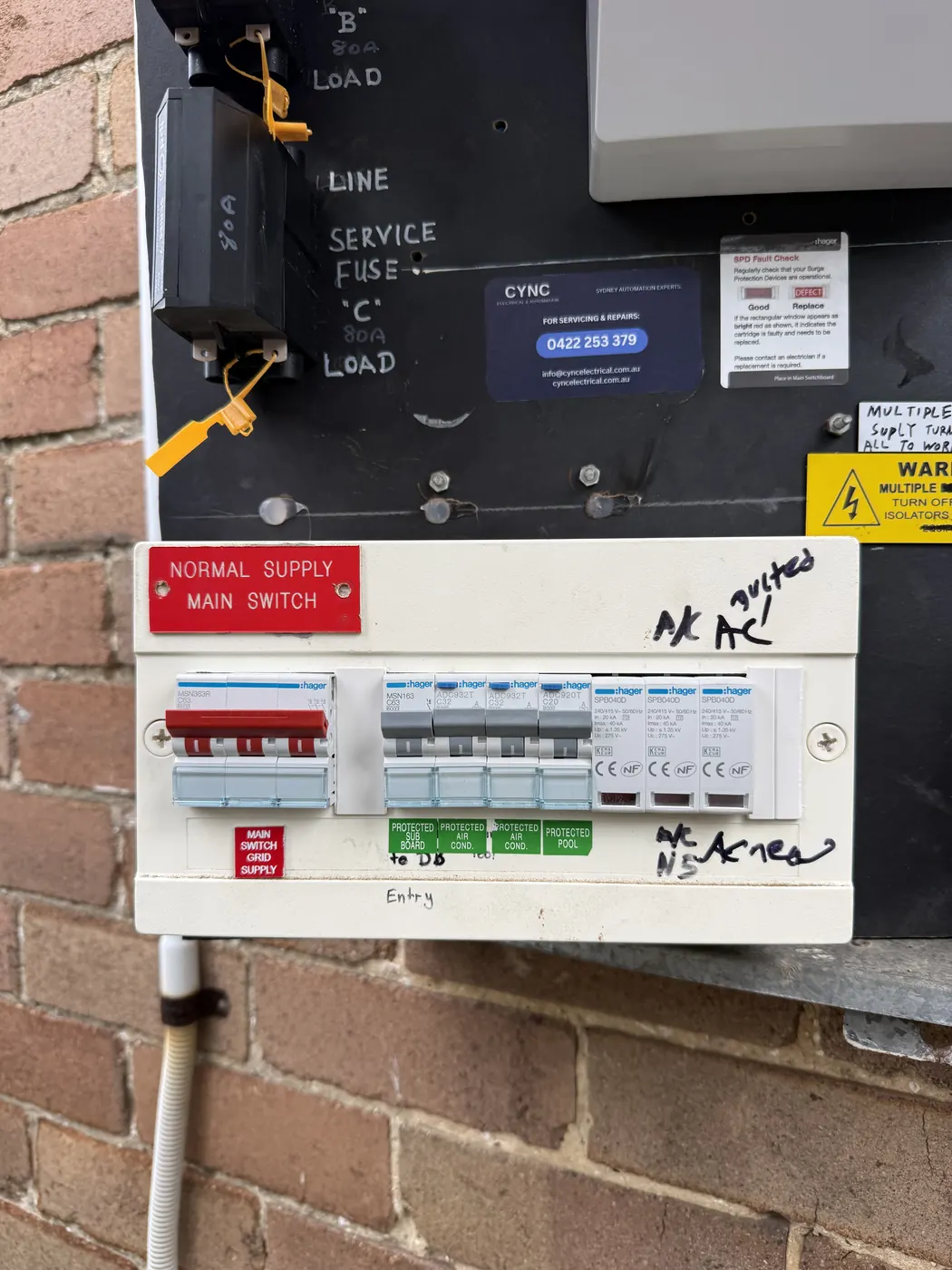
First: which switch actually tripped?
Open the switchboard door and look at what is off. The three things in there do different jobs, and knowing which one moved tells you what kind of fault you have.
- A safety switch (RCD) protects people. It watches the current going out against the current coming back, and cuts power in about 30 milliseconds if roughly 30 milliamps goes missing — because missing current is current flowing somewhere it shouldn't, possibly through a person. It usually covers several circuits at once and has a TEST button.
- A circuit breaker protects wiring. It trips on overload — too much plugged into one circuit — or on a short circuit. One per circuit, no test button.
- An RCBO is both in one device, one per circuit. Modern boards are usually full of them, which is good news: when one trips it names the circuit for you.
The rest of this is about the safety switch, because that is the one that trips "for no reason". A breaker tripping on overload is usually obvious — you turned on the kettle and the toaster on the same circuit.
Finding the culprit: the half-split
This is the method an electrician uses, and there is nothing stopping you doing the first pass yourself. It costs nothing but ten minutes.
- Unplug everything on the affected circuits. Everything — kettle, toaster, chargers, the fridge, the washing machine, the thing in the garage you forgot about. Turn off hardwired items at their wall switch (oven, hot water, air conditioning).
- Reset the safety switch. If it will not reset with everything unplugged, stop. The fault is in the fixed wiring, not an appliance, and that is where you call someone.
- If it holds, plug things back one at a time, waiting a minute between each. Turn each appliance on, don't just plug it in — some faults only appear under load, and a washing machine or dishwasher may only trip once it starts heating.
- The one that trips it is your answer. Leave it unplugged and get it repaired or replaced.
Work through the whole list even after you find one. It is common to find two marginal appliances rather than one bad one.
Why it trips "randomly" — accumulated leakage
This is the part most explanations leave out, and it is the reason a safety switch can trip on a Tuesday evening with nothing new plugged in.
Almost every appliance leaks a tiny amount of current to earth. A dishwasher element, a pool pump, an old fridge, a bathroom heater, anything with a filter in its power supply — each contributes a milliamp or two. Individually, none of them is faulty. But the safety switch does not see them individually. It sees the total, and it trips at around 30 milliamps.
So a house sitting at 26 milliamps of normal background leakage works perfectly until the evening the dishwasher, the dryer and the pool pump all run at once — and then it trips, apparently at random, and resets fine afterwards. Nothing is broken. The circuit is simply loaded to the point where ordinary leakage adds up.
The fix is not a bigger safety switch. It is splitting the load across more RCDs — which is one of the practical benefits of moving to a board full of RCBOs, where each circuit gets its own 30mA budget instead of sharing one.
If it tracks the weather, it's water
A safety switch that trips during or just after rain, and behaves perfectly in dry weather, has water getting into something. We see this constantly across the Hills, and it is nearly always one of a short list:
- Outdoor power points with a perished or missing weatherproof cover
- Garden and path lighting where a joint has been buried without a proper enclosure
- Pool and pond equipment
- Shed and outbuilding submains, particularly where a conduit has been damaged or a gland has failed — a long-standing favourite on acreage blocks
- A roof leak finding a ceiling rose or a downlight
- Bore and irrigation pumps
Water-related faults are frustrating to chase because they dry out before anyone arrives. Note the weather and the time each time it trips — that record is genuinely useful and it is the kind of thing an insulation resistance test can then confirm.
When it's the wiring, not an appliance
If the safety switch will not reset with every appliance unplugged, the leakage is in the fixed wiring. Common causes:
- Old cable with degraded insulation. Rubber-insulated wiring from before the 1960s becomes brittle and eventually leaks. Once it starts it does not stop, and the answer is rewiring rather than repair.
- Rodent damage in a roof space or subfloor.
- A nail or screw through a cable — very often traced to a picture hook, a new floor or a bathroom renovation from some months earlier.
- A failed appliance that is hardwired, so unplugging didn't remove it: the oven, the hot water element, the air conditioning, the range hood.
- A faulty safety switch. They have a service life like anything else, and one that trips with no load at all is suspect.
This is where insulation resistance testing earns its keep: we isolate each circuit and measure it, and the fault stops being a guess. That is the substance of our fault finding page.
What never to do
Never tape, wedge or hold a safety switch on. People do this. It removes the only thing standing between a fault and a person, and every part of why the device exists.
Never leave it off and run an extension lead from another circuit to get the fridge going. That circuit now carries the load it was not designed for, and you have moved the problem rather than solved it.
Don't ignore a switch that resets easily. "It trips but it goes straight back on" is not a mild version of the problem. It is the same fault, intermittent.
And if you have found that there is no safety switch in your board at all — only ceramic fuses or plain breakers — that is worth acting on regardless of what tripped. Safety switches have been required on new and altered circuits for a long time, and a great many Hills homes still have boards that predate them.
Common questions
Is a tripping safety switch dangerous?
The tripping isn't — that is the device working. What it is responding to may well be. A switch that trips repeatedly is reporting a real fault every time, and the fault is what needs finding.
Why does it only trip when it rains?
Water has found its way into an outdoor point, a garden light joint, pool equipment or a shed submain. It dries out and behaves again, which is why it is so often dismissed. An insulation resistance test on the suspect circuits finds it.
Nothing is plugged in and it still trips. What now?
The leakage is in the fixed wiring or in a hardwired appliance — the oven, hot water, air conditioning. That needs a licensed electrician with a tester; there is nothing further you can safely do yourself.
Can a safety switch itself go faulty?
Yes. They wear out, and one that trips with no load connected is a prime suspect. Press the TEST button monthly — if it does not trip instantly, it needs replacing.
Why did it start after I added an appliance?
Either that appliance has a fault, or it pushed the circuit's total background leakage past 30mA. Both are real; the second is why splitting circuits across RCBOs often solves a problem that swapping appliances doesn't.
Tripping you can't trace?
We test circuit by circuit and tell you what it actually is. Call 0422 253 379.