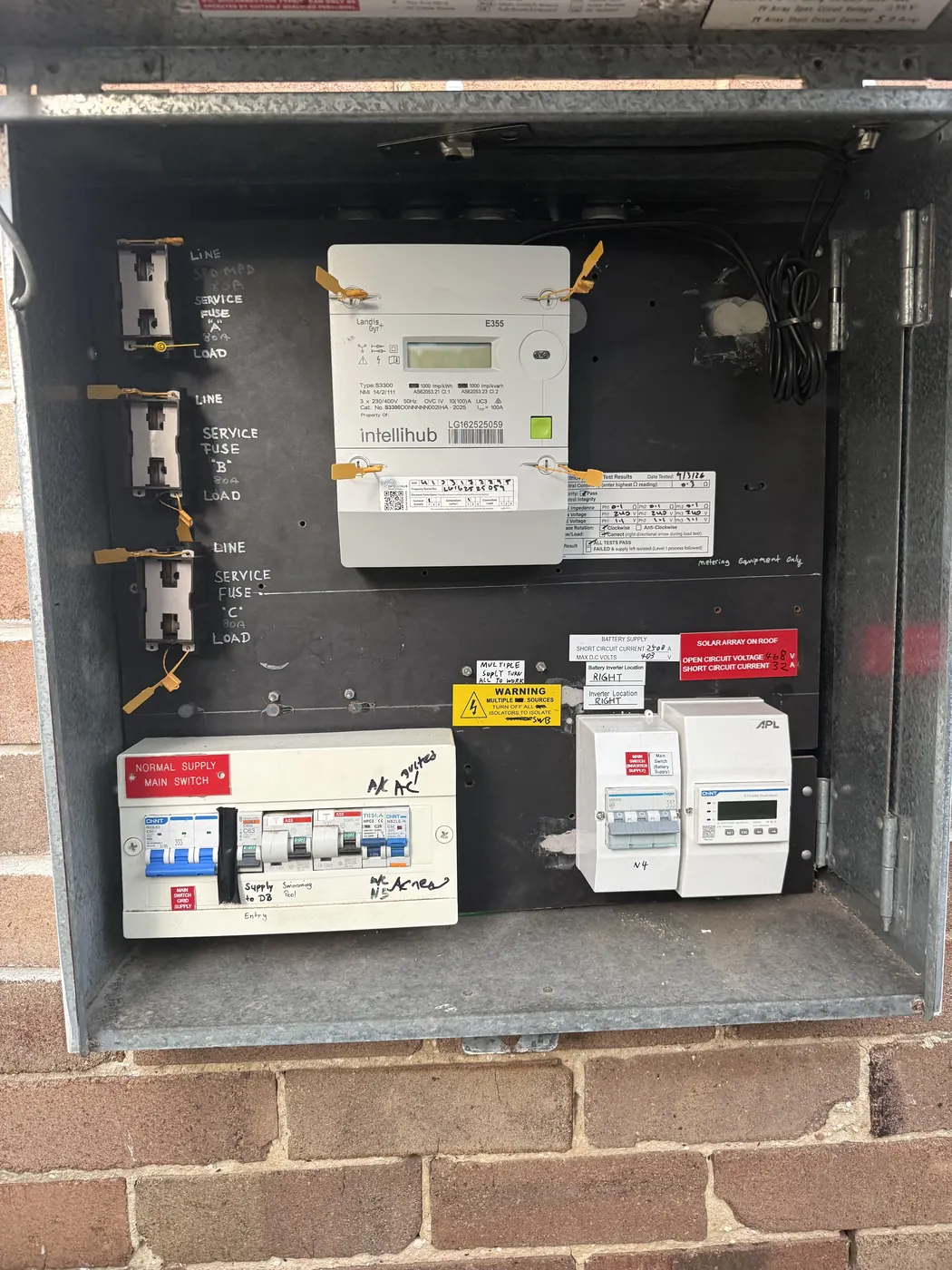
Who pays for the switchboard in an apartment — you or strata?
The short version: your sub-board and its fuses are your problem. The metering area and the mains feeding it are the owners corporation's. Where those two things meet is where most disputes happen.
Who pays for what
The general rule under NSW strata law — always check your scheme's by-laws and the strata plan, which can vary the detail.
| The job | Price |
|---|---|
| Sub-board and RCBOs/fuses inside your lotServes only your apartment | You (the owner) |
| Wiring and outlets inside your lotStandard lot owner responsibility | You (the owner) |
| Meter and metering area on common propertyUsually a shared cupboard or riser, even if it houses individual meters | Owners corporation |
| Mains/risers feeding the metering areaThe shared supply infrastructure | Owners corporation |
| Common property switchboard (foyer, car park, lifts)Services shared areas, not any one lot | Owners corporation |
| Damage to your sub-board caused by a common-property faulte.g. a shared main failing and taking out your board | Usually owners corporation — get it in writing before you pay |
This is general guidance, not legal advice. The exact line depends on your strata plan and by-laws, and a strata lawyer or your strata manager should confirm anything contested.
Why this actually comes up
Across the strata-heavy Lower and Mid North Shore — Mosman, Chatswood, Neutral Bay, Crows Nest and the growing apartment stock around St Leonards — the switchboard dispute is one of the most common electrical arguments in a building. It's rarely about who's responsible in principle; everyone agrees to the rule of thumb. It's about which side of the line a specific fault sits on.
A tripping RCBO inside your apartment is unambiguously yours. A dead common meter room light is unambiguously the owners corporation's. The disputes happen in between: a meter that's failed and is dragging your sub-board down with it, a shared riser that's degraded and causing nuisance trips in individual lots, or an old combined board where the metering and the sub-board were never properly separated when the building was wired — common in older 1970s–90s North Shore blocks before individual metering areas became standard practice.
Upgrading your own sub-board
You generally don't need strata approval to upgrade the switchboard that serves only your lot — it's inside your unit entitlement, the same as replacing your own hot water system. What you do need to check first:
- Whether your board is genuinely separate from common property metering, or combined with it — an older building sometimes has this blurred, and separating it out is worth doing as part of the upgrade.
- Access. If your board sits in a common-property cupboard or riser, you'll usually need to notify the strata manager or building manager even though you're not asking permission for the electrical work itself.
- By-laws specific to your scheme. Some buildings have by-laws about work near common property or requiring notice for trades entering shared areas — check before booking rather than after.
A standard single-phase sub-board upgrade runs the same as any domestic upgrade — see our switchboard upgrade cost guide for current pricing.
Strata switchboard questions
Who pays for the switchboard in an apartment — me or strata?
The sub-board and fuses inside your lot are your responsibility. The metering area and the mains feeding it are the owners corporation's, because they're common property. The dividing line is usually the meter.
Do I need approval to upgrade my own sub-board?
Generally no — it's inside your lot and your responsibility, similar to replacing an appliance. You may need to notify the strata or building manager if the work requires access to a common-property cupboard or riser.
What if the strata manager disputes it?
Get the electrician's assessment in writing — which board or component actually failed, and whether it's inside your lot or on common property — and put that to the strata manager or committee. Most disputes resolve once there's a clear technical answer rather than a guess. If it's genuinely contested, NSW Fair Trading's strata mediation service or a strata lawyer is the next step.
A common-property fault damaged my sub-board — who pays to fix it?
Usually the owners corporation, since the fault originated on common property. Document the fault (photos, an electrician's report noting the cause) before repairing, and raise it with the strata manager or committee before you pay out of pocket.
Our building has one old combined board for the whole floor — is that normal?
It was common in older buildings before individual metering areas became standard, but it makes responsibility genuinely unclear and is worth raising with the owners corporation. Separating it into individual metering and sub-boards is usually a common-property capital works item, not something one owner pays for alone.
What customers say
Excellent value and service, including follow-up.
Jason onsite quickly and completed the work on the spot, giving us a good price and was very polite. Would highly recommend.
Reliable and quality service.
These are Google reviews for our team at Cync Electrical & Automation — the licensed contractor behind North Shore Electrical & Automation. 5.0 from 20 reviews. — see the profile
Not sure which side of the line your fault is on?
Send us a photo of the board and we'll tell you what we're actually looking at. Call 0422 253 379.