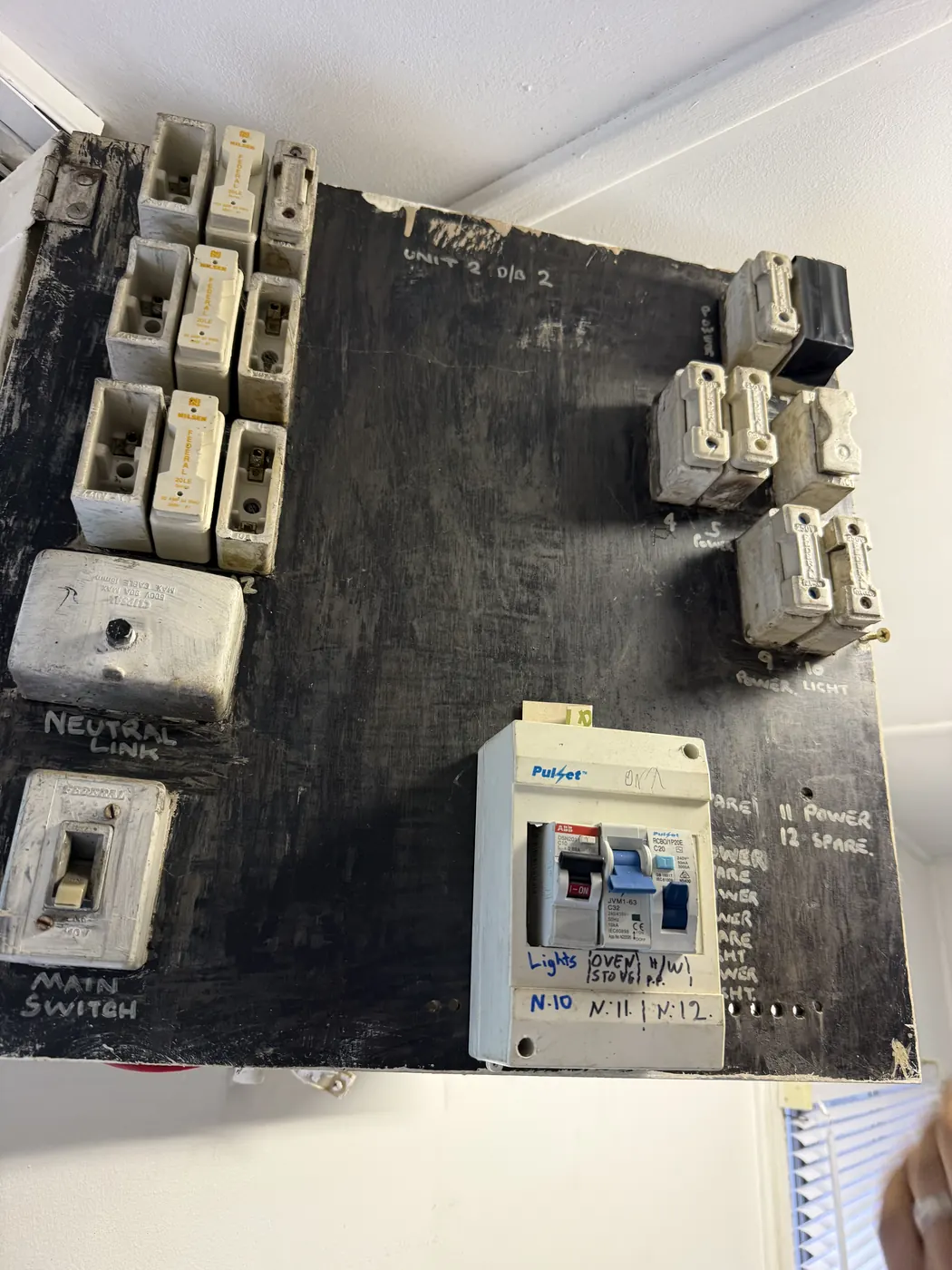
Electrician for heritage and large-block North Shore homes
Federation and inter-war wiring, ceramic fuse boards, overhead lines through heritage streetscapes, and the three-phase loads that come with a big block. Old and large properties don't get wired like a standard 600m² block, and treating them that way is why so much of it doesn't hold up.
What's actually behind the wall in a Federation home
Wahroonga, Killara, Lindfield, Mosman and Castlecrag all have the same problem hiding behind original picture rails: wiring that was never meant to last a century.
Rubber, VIR (vulcanised india rubber) and cotton-sheathed cable was standard until the 1960s. The insulation dries out, cracks and loses its rating long before anyone notices, because it usually still conducts — right up until it doesn't. Ceramic rewireable fuse boards are common behind that, offering no real fault protection and no path to add a safety switch without replacing the board. Meter panels backed with asbestos sheeting turn up constantly in pre-1990 homes and need licensed removal, not a standard swap.
Then there's the heritage overlay itself. A property in a conservation area, or a listed item, can have real constraints on what's visible from the street — a new meter box or switchboard sometimes needs a heritage-sympathetic location or finish, and council will occasionally have a view on it. We work with that rather than against it: routing new cabling through existing risers and roof space, and keeping visible fittings in character, so the upgrade doesn't turn into a fight with council.
Putting the power line underground
A lot of the leafiest streets on the Upper North Shore — Lindfield, Killara, Roseville Chase — still run overhead consumer mains through established tree canopy. Two problems come with that: the line goes down in a storm, and ageing or damaged overhead mains attract Ausgrid defect notices that then have to be actioned on a deadline.
Undergrounding your own service line — the cable from the point of attachment to your meter, not a whole-street council scheme — is Level 2 ASP (Accredited Service Provider) work. Indicative cost for the cable itself runs $80–$180 per metre, and a full private job — trenching, conduit, the new underground service and reinstating the overhead connection point — typically lands at $3,000–$12,000+ depending on distance and access. It's a common heritage-conservation-area choice too: no more overhead line crossing a period streetscape.
Three phase for a big house, not a farm
Three phase isn't just an acreage thing. A large North Shore home with a pool, ducted air conditioning, an EV charger and a battery can push past what a single phase supply comfortably carries — and it's a genuinely common combination on the bigger blocks around Ku-ring-gai and Hornsby Shire. Installed cost for bringing three phase to a property that doesn't have it, plus the board to suit, typically runs $6,500–$12,000+, depending on whether three phase mains already exist in the street.
Bushfire-adjacent properties
St Ives, North Turramurra and anything backing onto Ku-ring-gai Chase or Lane Cove National Park sit in a bushfire-prone area, which means external electrical fittings — meter boxes, outdoor power points, switchgear, security lighting — need to be BAL-rated to suit the property's Bushfire Attack Level. It's a straightforward spec once it's identified; the risk is a standard-grade fitting going up because nobody checked the BAL rating first.
Private power poles on long driveways
If your property sits well back from the street — common on the bigger blocks up here — the pole carrying power in from the road may be a private pole, meaning it's your responsibility to maintain and replace, not Ausgrid's. Ausgrid's own published indicative figures: a steel pole runs $3,000–$5,000, a large timber pole $7,500–$14,500, and up to $16,000 where the meter box needs replacing at the same time. This is Level 2 ASP work. See our full private power pole replacement cost guide for the detail.
Storms and falling branches
The Upper North Shore was among the worst-hit areas in Sydney's November 2019 "mini-tornado" storms, with Gordon and Killara the worst affected of the roughly 25,000 homes that lost power that day. It wasn't a one-off — falling branches account for roughly two-thirds of storm-related faults on Ausgrid's network, and heavy tree canopy over an overhead service line is exactly the setup a lot of these suburbs have. See our guide on why North Shore homes lose power in storms for what that means for backup and vegetation clearance.
Related work
The work that comes up again and again on heritage and large-block North Shore properties.
Switchboard upgrades
Ceramic fuses and asbestos-backed panels replaced properly.
Three phase power
Pools, ducted air, EV charging and batteries on one large-home load.
Generator changeover switches
Backup for properties that lose supply in a storm.
Surge protection
Overhead lines through tree canopy take more hits.
Heritage and large-block electrical questions
Can I upgrade my Federation home's electrics without damaging heritage features?
Generally yes. New cabling almost always routes through existing risers, wall cavities and roof space rather than through visible original fabric, and where a fitting has to be visible from the street in a conservation area we can usually match it to what council expects. Tell us upfront if the property is heritage-listed or in a conservation area and we'll plan around it rather than finding out on the day.
How much does it cost to put power lines underground?
Indicative cable cost is $80–$180 per metre, with a full private service-line job — trenching, conduit, the underground run and reconnection — typically $3,000–$12,000+ depending on distance and access. This is for your own service line, not a whole-street council undergrounding scheme, and it's Level 2 ASP work.
Do you replace private power poles?
Yes. If the pole between the street and your house is on your side of the property boundary it's usually your responsibility. Ausgrid's own published ranges are $3,000–$5,000 for a steel pole and $7,500–$14,500 for a large timber pole, up to $16,000 with a meter box replacement. It's Level 2 ASP work, which we coordinate.
My switchboard still has ceramic fuses — is that dangerous?
It means no safety switch protection is possible on that board and no way to add it without replacing it. It isn't automatically an emergency, but it is the reason we'd recommend prioritising an upgrade over most other electrical work on an old home.
Do I need three phase power for a large North Shore home?
Not automatically — plenty of large homes run fine on single phase. You need it where a pool, ducted air, an EV charger and a battery combine to exceed what a single phase supply carries, which is common but not universal on the bigger blocks. We'll work out your actual load rather than sell you an upgrade.
What is BAL-rated electrical equipment and do I need it?
BAL (Bushfire Attack Level) rating governs what external fittings — meter boxes, outdoor points, switchgear — are permitted on a bushfire-prone property. St Ives, North Turramurra and anything backing onto bushland typically needs it. We check the BAL rating before specifying anything external.
What customers say
Jason solved a really complex problem for our house with excellent professionalism and workmanship. Highly recommend, would def work with him again. On time delivery and within budget.
Excellent value and service, including follow-up.
Had a great experience with Jason — top guy at what he does. I recommend him.
These are Google reviews for our team at Cync Electrical & Automation — the licensed contractor behind North Shore Electrical & Automation. 5.0 from 20 reviews. — see the profile
Heritage home or large block not wired for what it's carrying now?
Tell us what's original, what's overhead, and what's at the far end of the block. Call 0422 253 379.